
System administration
Users, packages, disks, networking and the baseline the app depends on.
Patching, observation and a named path when something breaks — on hosts you already pay for.
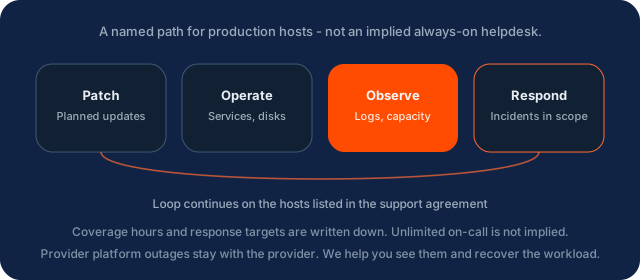
The management job
Operations for a listed set of machines. Not unlimited on-call unless the agreement says so. Provider incidents stay with the provider.
What is typically in scope
Users, packages, disks, networking and the baseline the app depends on.
Planned updates with service-impact awareness. Emergencies if the agreement covers them.
Web, database, queue and containers staying up and restarting cleanly.
Use logs to explain errors instead of restarting blindly.
CPU, memory, IO and slow queries when the app feels “just slow”.
Growth, inodes and backup footprint before the disk fills.
Access, backups, health and recovery for engines you already run.
Nginx or Apache vhosts, TLS and common 5xx investigation.
Structured diagnosis when a site or API is down, in contracted hours.
Alerts mapped to hosts you care about.
Bring the provider, the applications, and the hours you actually need someone to answer.
FAQ
System administration, patching, service management, log and performance review, database and web-server support, and incident troubleshooting within the agreed host list and hours.
Coverage hours and response targets are defined in the support agreement. We do not imply unlimited on-call unless that is contracted.
Usually yes, or an equivalent privileged role, for patching and incident work. Access is limited to what the work requires and remains under your account.
Platform incidents stay with the provider. We help you see the impact, recover the workload when the platform returns, and review whether the application can tolerate that class of failure.